Tomorrow is my last day at work. I've made a start at packing up the office (I have to pack everything into boxes as I don't quite know where I will be located when I return) but it seems like I have a long way to go.
I have been saying various goodbyes over the past few weeks and this has kind of brought things to the front of my mind a bit. I have also spent a few days in the ultrasound department at St Peter's trying to improve (actually, forget improve - develop) my scanning skills. I have had a great teacher there (Brenda) and she has been very patient with my inability to grasp the skill of locating the fetal position. However, I think I have finally got it and have even managed to do some reasonable scans with my new portable scanner. Yes, I managed to fundraise enough money to buy one portable scanner and so am able to start the triage project when I get there. The obstetric risk scoring system contains 3 factors that I can only obtain through scanning.
Part of me is excited about going to Gimbie and another part of me wonders exactly why I am going there. Right now, it feels a little bit like the anticipation that you have prior to a holiday (yes, I know this is no holiday). On the one hand you're really looking forward to it, but then you are not really quite sure what it will all be like. I'm sure that it'll all be fine in the end. I guess that my biggest fear remains that we will not be able to achieve very much and so will get frustrated with the systems that prevent us from doing what probably needs to be done.
Wednesday, 28 September 2011

Sunday, 18 September 2011
18th September 2011
Last Sunday was Ethiopian New Year and it is now 2004 over there. There are also two times (8 hours apart) that people work on so I think it is possible to never be late for anything!
With just 18 days to go until 'E' day, I'd like to be able to report that we are ready and prepared for the year ahead. Alas, that is not the case and we still haven't got our work permits, business visas or car documents sorted. Its not for the want of trying though. Over the past 4 or 5 months we have become regular customers of a local notary (to notarise many documents), the Foreign Commonwealth Office (to legalise the documents) the Ethiopian Embassy in London (to stamp said documents) and DHL, who finally get to send all these documents to a PO box in Addis. The real problem is that no-one seems to know exactly what is required for a work permit or for importing a car. So we provide everything that is asked for, only to find that there are further things needed; each time this involves various trips to get them authorised by everyone. Our work permit has required; a letter form the GP saying we are healthy, a letter from the charity offering us a job, a job description and terms of reference, photocopies of our passports, copies of qualifications, and copies of a bank statement to show you have enough money to support yourself. All this has to be shown to be genuine documentation and hence notarised, legalised and stamped.
We are just about to pack the car, which will hopefully arrive after 30 days on a ship, into Djibouti. It's not clear how hard it will be to get the car through customs but so far, things do not look good - again, no-one really knows what you have to provide. The other problem is that it's not clear what you can take into the country and what you have to pay tax on. Apparently, personal items are fine, but then a friend got stopped and charged £40 to bring her laptop through. I think these 'rules' are all a bit random and rely on visitors carrying enough cash with them to get through.
With just 18 days to go until 'E' day, I'd like to be able to report that we are ready and prepared for the year ahead. Alas, that is not the case and we still haven't got our work permits, business visas or car documents sorted. Its not for the want of trying though. Over the past 4 or 5 months we have become regular customers of a local notary (to notarise many documents), the Foreign Commonwealth Office (to legalise the documents) the Ethiopian Embassy in London (to stamp said documents) and DHL, who finally get to send all these documents to a PO box in Addis. The real problem is that no-one seems to know exactly what is required for a work permit or for importing a car. So we provide everything that is asked for, only to find that there are further things needed; each time this involves various trips to get them authorised by everyone. Our work permit has required; a letter form the GP saying we are healthy, a letter from the charity offering us a job, a job description and terms of reference, photocopies of our passports, copies of qualifications, and copies of a bank statement to show you have enough money to support yourself. All this has to be shown to be genuine documentation and hence notarised, legalised and stamped.
We are just about to pack the car, which will hopefully arrive after 30 days on a ship, into Djibouti. It's not clear how hard it will be to get the car through customs but so far, things do not look good - again, no-one really knows what you have to provide. The other problem is that it's not clear what you can take into the country and what you have to pay tax on. Apparently, personal items are fine, but then a friend got stopped and charged £40 to bring her laptop through. I think these 'rules' are all a bit random and rely on visitors carrying enough cash with them to get through.
Thursday, 7 July 2011
7th July 2011
As the departure date gets nearer and nearer, I am beginning to wonder exactly what I am going to achieve over the year. There are many possible projects that I feel I can contribute towards but I think it's important to start my time there with a specific focus. My main interest is in improving the referral system between the community and the hospital. Whilst I was in Gimbie last February, I was struck by the realisation that many of the women having their babies in the hospital didn't need to be there, yet many of the women having their babies at home seriously needed to be in hospital. Indeed, without the hospital treatment, these women were dying or suffering with serious life-long complications such as a fistula between the uterus and bladder.
Unlike the UK, the majority of women in Ethiopia (94%) have their babies at home. For many women, this is fine and they are able to have a safe childbirth. However, when things start to go wrong, the nearest hospital or health centre can be 5 or 6 hours walk away. Transportation is virtually non-existent in the villages and so women either have to walk to hospital or they are carried on a stretcher made by the family. As you might imagine, many of these women die on this rather hazardous journey to hospital, or they arrive too late to hospital for anything to be done.
The following letter was published in a paper that describes the problems of delays in getting to hospital and even though I have read it many times, it still horrifies me to think of the suffering that many families experience every day:
Unlike the UK, the majority of women in Ethiopia (94%) have their babies at home. For many women, this is fine and they are able to have a safe childbirth. However, when things start to go wrong, the nearest hospital or health centre can be 5 or 6 hours walk away. Transportation is virtually non-existent in the villages and so women either have to walk to hospital or they are carried on a stretcher made by the family. As you might imagine, many of these women die on this rather hazardous journey to hospital, or they arrive too late to hospital for anything to be done.
The following letter was published in a paper that describes the problems of delays in getting to hospital and even though I have read it many times, it still horrifies me to think of the suffering that many families experience every day:
Today Mary, the lady who helps us in the house came late to work. I told her off for being late and asked why. She said that one of her townswomen had died in the hospital while giving birth to a baby. This was her fifth delivery….. By the time they found a vehicle to go to hospital, by the time they struggled to get her an admission card. By the time she was admitted, by the time her file was made up, by the time the midwife was called, by the time the midwife came, by the time the husband went and bought some gloves, by the time the gloves were brought to the hospital, by the time the midwife was called, by the time the midwife came. By the time the midwife examined the woman, by the time the bleeding started, by the time the doctor was called. By the time the doctor could be found, by the time the ambulance went to find the doctor. By the time the doctor came. By the time the husband went out to buy drugs, IV set, drip and bottle of ether, by the time the husband went round to look for blood bags all round town, by the time the husband found one and by the time the husband begged the pharmacist to reduce the prices since he had already spent all his money on the swabs, dressings, drugs and fluids, by the time the haematologist was called. By the time the haematologist came and took blood from the poor tired husband, by the time the day and night nurses changed duty….. and the husband signed the consent form, the woman died. Today the husband wanted to sell the drugs and other things they never used to be able to carry the body of his wife back to their village but he could never trace the body again in the hospital.
Wednesday, 15 June 2011
15th June 2011
Although October still sounds like a long way away, it's actually just 15 weeks. Now that triggers just a little drop of anxiety in my mind. We've finally managed to get a left-hand drive car. Actually, it's more like a truck. I drove it to London the other evening for a test drive and felt like I was competing with the double decker buses. Being a Land cruiser 'Amazon' - apparently this is the bees knees for Africa - it should be hardy enough to take us (and plenty of luggage) around the rugged hills of Ethiopia. That is, of course, if the various bits of paperwork get to the right people at the right time. I am currently compiling a list of all things that are going to be in the car when it is shipped over to Djibouti. So far, the list contains a variety of cleaning products, some tins of tuna fish, a mosquito net and a range of medical supplies. I have also just found out that there is a newish vaccination called Dukoral, which although is given for Cholera prevention, it also provides protection against amoebic dysentery; something I'm particularly keen to avoid.
Saturday, 26 February 2011
25th February 2011
Well, we're back in the UK, having had a really interesting trip to Gimbie. I had hoped to update this blog whilst there, but establishing a means of accessing the internet was more of a challenge than I thought it'd be. It's not impossible, but just needs some time to register an account - so a couple of hours queuing in a communications office in Addis should do it. This will be top of the list of things to sort out when we return in October.
Ethiopia really is a very pretty country and the people were largely very friendly, if not totally amused by the presence of faranj (foreigners). Indeed, such was the amusement of a couple of white faces appearing in the town, that both children and adults would giggle and point at us before being bold enough to shout out 'faranj' or if that didn't invoke a reaction, 'you, you, you, faranj'. I guess that these are the few English words that they know. Below is a typical view of the interested faces that look quizzically at the faranj.

The city of Addis Ababa was largely what I expected it to be - lots of people walking about, venders selling fruit and vegetables, some pretty tatty looking bars and many, many cars tooting their horns in an attempt to get through the traffic. The pollution was a lot worse than I expected and after a couple of hours wandering along the streets, it was a relief to get back to the hotel, which was off of the main roads. What I hadn't anticipated was the extent to which Ethiopia's alleged 80 million people were packed into village after village along the road out of Addis. I thought that once we got out of the capital, there would be vast areas of empty spaces, with the odd village along the way. What I saw was thousands of people living in a variety of dwellings built along the roadside. Each time you drive through a village, you have to avoid the mass of people walking along the road going from one part of the village to another. Most villages have pavements, but they are in such poor condition that it is less hazardous to walk on the road. Below are a couple of pictures taken along the drive from Addis to Gimbie.


We had a 13 hour drive from Addis to Gimbie, which is where the hospital is located. The slightly longer journey was due to the car's clutch finally breaking, after many miles trying to keep it working by driving at less than 10 miles an hour with smoke bellowing through the gear lever housing unit. Having been towed the last part of the journey, we finally arrived at the accommodation in Gimbie hospital. The photo below is the entrance to the hospital.

For now, all I'm going to say is that the house was really very basic - but in comparison to what the majority of the villagers are living in, it probably seemed like a palace. The picture below is likely to be the house that we will live in when we stay for the year.

The hospital is also pretty basic in that there isn't much in the way of equipment and what is there is fairly old and often broken.

I was quite surprised at the level of hygiene in the hospital and at first, wondered whether I would ever be able to spend more than a few minutes amongst the stench that pours out of the Obs and gynae ward. In the end you get used to it and luckily the house had plenty of hot water - which is more than I can say for the hospital, which relies totally on cold water from the stream below.
I saw some amazing sights in the hospital during the week; on the maternity ward, the tightly packed beds, most housing a new mother and her baby (those women who lost their babies were also in the same ward) were full of smiling women, probably relieved that they and their baby had survived the process of childbirth. The majority of births occur at home, but when women are concerned about their baby or the labour looks like it is going on for too long, they often have to walk for hours to get to the hospital. By this time, for some women it is too late to save the baby but hopefully it is possible to save the mother.
The other wards also contained patients with conditions that you would just never see in the Western world; quite a few children with burns, having fallen onto the fire in the house; a child with obstructed airways, who, following an adrenaline nebuliser had a leech crawl out of his mouth (the leech came from drinking river water); a child with such bad malnutrition that I was reminded of the 1980s Ethiopian famine; and patients with a variety of unknown, but probably infectious conditions. Most people have hook worm and so there is also a very high prevalence of reflux, which is very likely caused by the hook worm.
There are lots of opportunities do contribute to health care here in Gimbie and also some clear research opportunities that may actually lead to improvements in health care. I have a few ideas now and am keen to get on with the development of a research proposal. It's not going to be easy, simply because it is difficult to follow people up once they have left the hospital. However, patients do have medical records and although they are not always complete, it does allow you to start somewhere. Below is one of the education centers in Gimbie town - I assume it is closed....

The town of Gimbie (see picture below) is much like the many other towns that we passed through on the way to Gimbie - very busy with people walking everywhere and heavy trucks carrying goods driving through.

Goats and cows also wander the streets, looking for scraps of food and skulking in the shade wherever they can.

Although I had heard that there wasn't a great deal of variety in food; I hadn't quite appreciated how little choice there was. The only things that were readily available were; onions, potatoes, tomatoes, avocados, mangos, bananas, and oranges. It was also possible to get some kind of lentil or bean (dried), white bread, oats and some tins of tuna and sardines (from one or two places). There was, however, a very nice 'bar' called Jimi Juice, which served fantastic juices, all freshly squeezed. This is definitely going to be a regular visiting place.
So will it be possible to survive a year in Gimbie?
Undoubtedly challenging but certainly possible and hopefully, in many ways, enjoyable.
Ethiopia really is a very pretty country and the people were largely very friendly, if not totally amused by the presence of faranj (foreigners). Indeed, such was the amusement of a couple of white faces appearing in the town, that both children and adults would giggle and point at us before being bold enough to shout out 'faranj' or if that didn't invoke a reaction, 'you, you, you, faranj'. I guess that these are the few English words that they know. Below is a typical view of the interested faces that look quizzically at the faranj.

The city of Addis Ababa was largely what I expected it to be - lots of people walking about, venders selling fruit and vegetables, some pretty tatty looking bars and many, many cars tooting their horns in an attempt to get through the traffic. The pollution was a lot worse than I expected and after a couple of hours wandering along the streets, it was a relief to get back to the hotel, which was off of the main roads. What I hadn't anticipated was the extent to which Ethiopia's alleged 80 million people were packed into village after village along the road out of Addis. I thought that once we got out of the capital, there would be vast areas of empty spaces, with the odd village along the way. What I saw was thousands of people living in a variety of dwellings built along the roadside. Each time you drive through a village, you have to avoid the mass of people walking along the road going from one part of the village to another. Most villages have pavements, but they are in such poor condition that it is less hazardous to walk on the road. Below are a couple of pictures taken along the drive from Addis to Gimbie.


We had a 13 hour drive from Addis to Gimbie, which is where the hospital is located. The slightly longer journey was due to the car's clutch finally breaking, after many miles trying to keep it working by driving at less than 10 miles an hour with smoke bellowing through the gear lever housing unit. Having been towed the last part of the journey, we finally arrived at the accommodation in Gimbie hospital. The photo below is the entrance to the hospital.

For now, all I'm going to say is that the house was really very basic - but in comparison to what the majority of the villagers are living in, it probably seemed like a palace. The picture below is likely to be the house that we will live in when we stay for the year.

The hospital is also pretty basic in that there isn't much in the way of equipment and what is there is fairly old and often broken.

I was quite surprised at the level of hygiene in the hospital and at first, wondered whether I would ever be able to spend more than a few minutes amongst the stench that pours out of the Obs and gynae ward. In the end you get used to it and luckily the house had plenty of hot water - which is more than I can say for the hospital, which relies totally on cold water from the stream below.
I saw some amazing sights in the hospital during the week; on the maternity ward, the tightly packed beds, most housing a new mother and her baby (those women who lost their babies were also in the same ward) were full of smiling women, probably relieved that they and their baby had survived the process of childbirth. The majority of births occur at home, but when women are concerned about their baby or the labour looks like it is going on for too long, they often have to walk for hours to get to the hospital. By this time, for some women it is too late to save the baby but hopefully it is possible to save the mother.
The other wards also contained patients with conditions that you would just never see in the Western world; quite a few children with burns, having fallen onto the fire in the house; a child with obstructed airways, who, following an adrenaline nebuliser had a leech crawl out of his mouth (the leech came from drinking river water); a child with such bad malnutrition that I was reminded of the 1980s Ethiopian famine; and patients with a variety of unknown, but probably infectious conditions. Most people have hook worm and so there is also a very high prevalence of reflux, which is very likely caused by the hook worm.
There are lots of opportunities do contribute to health care here in Gimbie and also some clear research opportunities that may actually lead to improvements in health care. I have a few ideas now and am keen to get on with the development of a research proposal. It's not going to be easy, simply because it is difficult to follow people up once they have left the hospital. However, patients do have medical records and although they are not always complete, it does allow you to start somewhere. Below is one of the education centers in Gimbie town - I assume it is closed....

The town of Gimbie (see picture below) is much like the many other towns that we passed through on the way to Gimbie - very busy with people walking everywhere and heavy trucks carrying goods driving through.
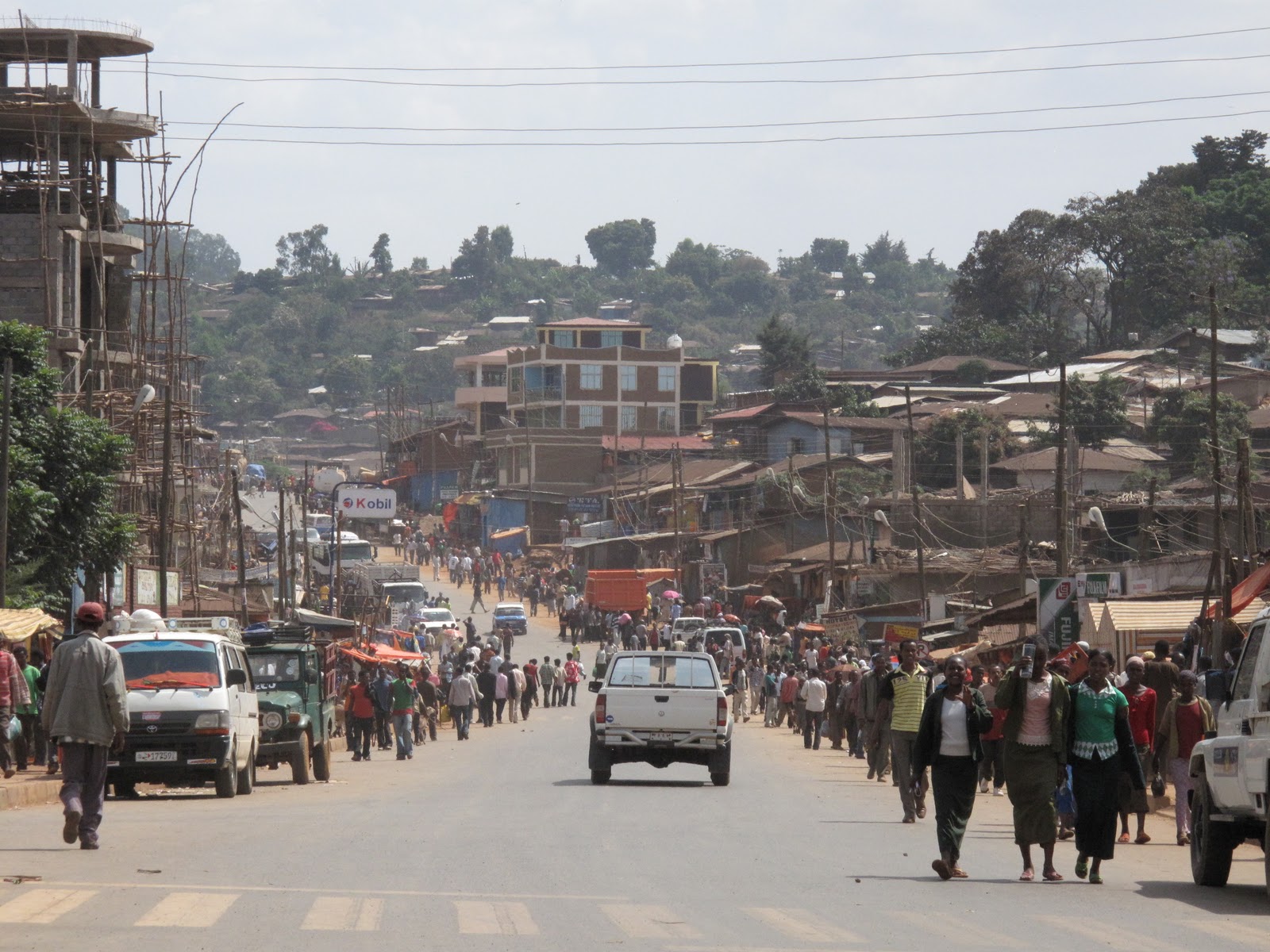
Goats and cows also wander the streets, looking for scraps of food and skulking in the shade wherever they can.

Although I had heard that there wasn't a great deal of variety in food; I hadn't quite appreciated how little choice there was. The only things that were readily available were; onions, potatoes, tomatoes, avocados, mangos, bananas, and oranges. It was also possible to get some kind of lentil or bean (dried), white bread, oats and some tins of tuna and sardines (from one or two places). There was, however, a very nice 'bar' called Jimi Juice, which served fantastic juices, all freshly squeezed. This is definitely going to be a regular visiting place.
So will it be possible to survive a year in Gimbie?
Undoubtedly challenging but certainly possible and hopefully, in many ways, enjoyable.
Friday, 11 February 2011
11th February 2011
OK, so now I'm seriously excited about our upcoming trip. We've now got our international driving licenses through........although we have not succeeded in our pursuits at hiring a car. It seems that you have to hire a driver as well as a car, which I guess is OK, but then you have to look after the driver for the duration, which is not so easy. I don't think that even and Ethiopian driver wold appreciate sleeping in a car for 10 days. So the next plan is to try and borrow the Maternity Worldwide car (and driver) for our trips put and about. Perhaps they have some good bicycles.
I'm off to buy some essentials for the trip - by this, I mean food. I thought that some mixed spicy beans and some half baked bread would be a good start and then I guess some cereal, long life milk, biscuits and whatever else I can fit into the case. It says on the Ethiopian airlines website that we can have 2 x 23kg bags each, which is pretty good for cattle class. So I'm thinking of taking one bag for clothes and the other for food!
I'm off to buy some essentials for the trip - by this, I mean food. I thought that some mixed spicy beans and some half baked bread would be a good start and then I guess some cereal, long life milk, biscuits and whatever else I can fit into the case. It says on the Ethiopian airlines website that we can have 2 x 23kg bags each, which is pretty good for cattle class. So I'm thinking of taking one bag for clothes and the other for food!
Monday, 7 February 2011
7th February 2011
The next hurdle in our preparations is communication. In order to get the most out of our time in ethiopia, we really need to be able to speak the language. Aahhh, but which one do we choose? The villagers living in the area of Oromo speak Oromifa and the majority of hospital workers speak Amharic. I think that many of the nurses and doctors also speak some English, although I'm not sure how fluently. There are around 77 different languages spoken in Ethiopia, so I guess we're lucky to have to choose between just two. Ideally, we should speak both Oromifa and Amharic but let's not get too carried away.
On the basis that we want to ideally communicate with the 'locals', we've decided to learn Oromifa. This may sound easy enough but we have been confronted with the fact that there appears to be very little written Oromifa around. Many hours of trawling on the net made me conclude that a visit to the School of African Studies is necessary. It may also be possible to pick up a dictionary from the area when we have our brief visit soon. So far, I've learnt around 100 words but have no idea how to string them together.
On the basis that we want to ideally communicate with the 'locals', we've decided to learn Oromifa. This may sound easy enough but we have been confronted with the fact that there appears to be very little written Oromifa around. Many hours of trawling on the net made me conclude that a visit to the School of African Studies is necessary. It may also be possible to pick up a dictionary from the area when we have our brief visit soon. So far, I've learnt around 100 words but have no idea how to string them together.
Subscribe to:
Posts (Atom)