Well, we're back in the UK, having had a really interesting trip to Gimbie. I had hoped to update this blog whilst there, but establishing a means of accessing the internet was more of a challenge than I thought it'd be. It's not impossible, but just needs some time to register an account - so a couple of hours queuing in a communications office in Addis should do it. This will be top of the list of things to sort out when we return in October.
Ethiopia really is a very pretty country and the people were largely very friendly, if not totally amused by the presence of faranj (foreigners). Indeed, such was the amusement of a couple of white faces appearing in the town, that both children and adults would giggle and point at us before being bold enough to shout out 'faranj' or if that didn't invoke a reaction, 'you, you, you, faranj'. I guess that these are the few English words that they know. Below is a typical view of the interested faces that look quizzically at the faranj.
The city of Addis Ababa was largely what I expected it to be - lots of people walking about, venders selling fruit and vegetables, some pretty tatty looking bars and many, many cars tooting their horns in an attempt to get through the traffic. The pollution was a lot worse than I expected and after a couple of hours wandering along the streets, it was a relief to get back to the hotel, which was off of the main roads. What I hadn't anticipated was the extent to which Ethiopia's alleged 80 million people were packed into village after village along the road out of Addis. I thought that once we got out of the capital, there would be vast areas of empty spaces, with the odd village along the way. What I saw was thousands of people living in a variety of dwellings built along the roadside. Each time you drive through a village, you have to avoid the mass of people walking along the road going from one part of the village to another. Most villages have pavements, but they are in such poor condition that it is less hazardous to walk on the road. Below are a couple of pictures taken along the drive from Addis to Gimbie.
We had a 13 hour drive from Addis to Gimbie, which is where the hospital is located. The slightly longer journey was due to the car's clutch finally breaking, after many miles trying to keep it working by driving at less than 10 miles an hour with smoke bellowing through the gear lever housing unit. Having been towed the last part of the journey, we finally arrived at the accommodation in Gimbie hospital. The photo below is the entrance to the hospital.
For now, all I'm going to say is that the house was really very basic - but in comparison to what the majority of the villagers are living in, it probably seemed like a palace. The picture below is likely to be the house that we will live in when we stay for the year.
The hospital is also pretty basic in that there isn't much in the way of equipment and what is there is fairly old and often broken.
I was quite surprised at the level of hygiene in the hospital and at first, wondered whether I would ever be able to spend more than a few minutes amongst the stench that pours out of the Obs and gynae ward. In the end you get used to it and luckily the house had plenty of hot water - which is more than I can say for the hospital, which relies totally on cold water from the stream below.
I saw some amazing sights in the hospital during the week; on the maternity ward, the tightly packed beds, most housing a new mother and her baby (those women who lost their babies were also in the same ward) were full of smiling women, probably relieved that they and their baby had survived the process of childbirth. The majority of births occur at home, but when women are concerned about their baby or the labour looks like it is going on for too long, they often have to walk for hours to get to the hospital. By this time, for some women it is too late to save the baby but hopefully it is possible to save the mother.
The other wards also contained patients with conditions that you would just never see in the Western world; quite a few children with burns, having fallen onto the fire in the house; a child with obstructed airways, who, following an adrenaline nebuliser had a leech crawl out of his mouth (the leech came from drinking river water); a child with such bad malnutrition that I was reminded of the 1980s Ethiopian famine; and patients with a variety of unknown, but probably infectious conditions. Most people have hook worm and so there is also a very high prevalence of reflux, which is very likely caused by the hook worm.
There are lots of opportunities do contribute to health care here in Gimbie and also some clear research opportunities that may actually lead to improvements in health care. I have a few ideas now and am keen to get on with the development of a research proposal. It's not going to be easy, simply because it is difficult to follow people up once they have left the hospital. However, patients do have medical records and although they are not always complete, it does allow you to start somewhere. Below is one of the education centers in Gimbie town - I assume it is closed....
The town of Gimbie (see picture below) is much like the many other towns that we passed through on the way to Gimbie - very busy with people walking everywhere and heavy trucks carrying goods driving through.
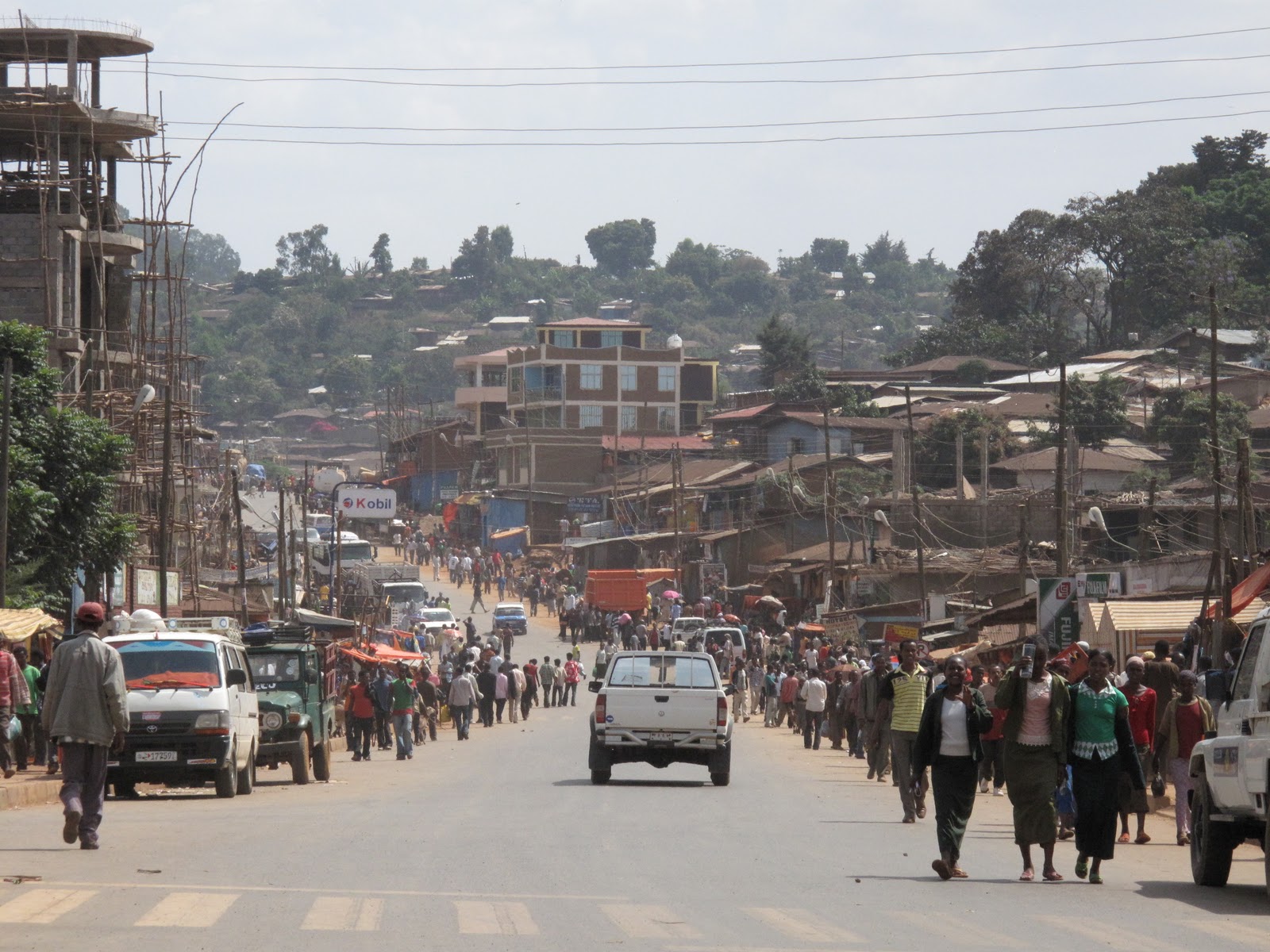
Goats and cows also wander the streets, looking for scraps of food and skulking in the shade wherever they can.
Although I had heard that there wasn't a great deal of variety in food; I hadn't quite appreciated how little choice there was. The only things that were readily available were; onions, potatoes, tomatoes, avocados, mangos, bananas, and oranges. It was also possible to get some kind of lentil or bean (dried), white bread, oats and some tins of tuna and sardines (from one or two places). There was, however, a very nice 'bar' called Jimi Juice, which served fantastic juices, all freshly squeezed. This is definitely going to be a regular visiting place.
So will it be possible to survive a year in Gimbie?
Undoubtedly challenging but certainly possible and hopefully, in many ways, enjoyable.
Saturday, 26 February 2011
Friday, 11 February 2011
11th February 2011
OK, so now I'm seriously excited about our upcoming trip. We've now got our international driving licenses through........although we have not succeeded in our pursuits at hiring a car. It seems that you have to hire a driver as well as a car, which I guess is OK, but then you have to look after the driver for the duration, which is not so easy. I don't think that even and Ethiopian driver wold appreciate sleeping in a car for 10 days. So the next plan is to try and borrow the Maternity Worldwide car (and driver) for our trips put and about. Perhaps they have some good bicycles.
I'm off to buy some essentials for the trip - by this, I mean food. I thought that some mixed spicy beans and some half baked bread would be a good start and then I guess some cereal, long life milk, biscuits and whatever else I can fit into the case. It says on the Ethiopian airlines website that we can have 2 x 23kg bags each, which is pretty good for cattle class. So I'm thinking of taking one bag for clothes and the other for food!
Monday, 7 February 2011
7th February 2011
The next hurdle in our preparations is communication. In order to get the most out of our time in ethiopia, we really need to be able to speak the language. Aahhh, but which one do we choose? The villagers living in the area of Oromo speak Oromifa and the majority of hospital workers speak Amharic. I think that many of the nurses and doctors also speak some English, although I'm not sure how fluently. There are around 77 different languages spoken in Ethiopia, so I guess we're lucky to have to choose between just two. Ideally, we should speak both Oromifa and Amharic but let's not get too carried away.
On the basis that we want to ideally communicate with the 'locals', we've decided to learn Oromifa. This may sound easy enough but we have been confronted with the fact that there appears to be very little written Oromifa around. Many hours of trawling on the net made me conclude that a visit to the School of African Studies is necessary. It may also be possible to pick up a dictionary from the area when we have our brief visit soon. So far, I've learnt around 100 words but have no idea how to string them together.
Thursday, 3 February 2011
3rd February 2011
In less than 2 weeks, we will be landing in Addis Ababa to spend 10 days in and around the area of Gimbie. We have had our vaccinations already as we needed some of them for a recent visit to Botswana and Namibia and so we thought we may as well get the extra ones needed for Ethiopia - Rabies, Yellow Fever and meningitis. We're not sure how high the malaria risk is as Gimbie is around 2000 meters high and so presumably not such a popular place for mosquitoes. Mind you, we have bought a mosquito net for the bed and also stocked up on Malarone for our brief visit.........just in case. I haven't a clue what you do for a whole year as it seems a bit problematic to take anti-malaria drugs for 12 months (not least of all because of the cost - they are around £2 a tablet).
We're wondering what the weather will be like. I had always thought that Ethiopia was very hot - I guess I still have the images of the 1980's Ethiopian famine in my mind, where television cameras illustrated the desperate dehydration and starvation of hundreds of thousands of families living in what appeared to be total desert land. In fact, it seems from what I have read, that Ethiopia is quite a lush country, and although the land is pretty rugged in many areas, there is plenty of green shrubbery and forestry around. During the rainy months (July and August), I think they get around 6 inches of rain a day. The temperature over the next few weeks is supposed to be around 24C and so we'll have to take our sun screen as well as mosi spray.
Saturday, 29 January 2011
Back to nursing
Having trained as a general nurse in 1981, I think that these, by now, rather rusty skills, will now come in handy when I am in Ethiopia. So I am getting myself back on the nursing register. Foolishly, I thought that my nursing days were over and so didn't maintain my registration. My advice to anyone thinking of not paying that annual fee to the NMC is "you never know what you might end up doing, so keep your registration going". In order to get my PIN back I have to do at least 75 hours in practice, be signed off as competent in a variety of things, attend a University 'Return to Practice' course and finally pass the academic assessments. Perhaps it doesn't sound like much - after all, you might say, you have to think about patient safety - however, trying to do this whilst holding down a full-time job and planning a trip to Ethiopia is a skilled juggling act. Sometimes those balls come tumbling down.
So yesterday I did my 2nd shift on the ward after a 15 year break away from any hands-on clinical work. A few things strike me about nursing in 2011:
1) There seem to be a lot of 'specialist nurses', who presumably have quite tightly defined roles in looking after things like 'tissue viability', 'stomas', 'manual handling' etc etc. I want to avoid saying 'when I was nursing..... or in my days.....' but just can't resist. So, when I was nursing, 3 years of what I believe was excellent training, equipped me for total patient care. We were trained in numerous skills (including wound care, stoma care and how to 'handle' patients) and had a professional duty to update those skills. Actually, it wasn't so much of a professional duty, although clearly that was important, but we were interested in keeping up-to-date. Being a nurse was something to be proud of and we wanted to make sure that we did a good job.
It is also apparent to me that there is now a team division; into specialist and generalist nurses. The generalists work shift hours and provide the day-today care, whereas the specialists work 9-5 and float between several wards. Of great surprise to me was the subtle shift to specialists writing their reports in the medical patient notes. Who are they writing their reports for? Are they supposed to be working with the general nurses to improve patient care? If so, why aren't their reports filed alongside the nursing reports? Of great amusement was the specialists nurse's note that said she carried out a wound care procedure under the supervision of a Foundation 1 year trainee doctor. Isn't the specialist nurse supposed to be the expert?
I'm sure that the specialist nurses provide just that - specialist care - but I can't help wondering whether this shift to specialism has not only created an unhelpful division in nursing, but has also left the general nurse de-skilled in certain areas. Patients are whole people and need to be cared for as whole people. Surely this includes their wounds, pressure areas and stomas?
2) Despite the increasing number of specialist nurses, very little has actually changed in the delivery of care. Increasing technology has meant that the many policies and procedures that dictate how every procedure needs to be carried out, can be accessed from the hospital intranet at the click of a button. I haven't actually seen anyone accessing these policies and procedures but presumably they will when they need to.......
One advantage of having such detailed and prescribed care is that nurses are not spending their time writing out pages of care plans - they just print one of the standard care plans off. So they don't even need to think about the care plan. And that's the point. They don't have to, and it seems to me, often don't , stop to think about the plan of care. Now maybe they are just all very aware of what care the patient needs and so don't need to refer to any notes. If they did look at the care plans, they are likely to find that they are very out of date - often being put there when the patient was admitted but never really looked at again.
3) I have been struck by the amount of time that qualified nurses spend on doing things that less qualified people could easily do. Why are nurses filling up the empty boxes of gloves, aprons etc etc, making fresh breakfast to replace the old one left to go cold on the side, cleaning bed areas, and taking dirty laundry and rubbish out? These are just a few things that a qualified nurse spends the day doing.
4) The nursing 'culture' is alive and well. Similarly to doctors who it has been shown learn how to be a doctor (culturised into the role), nurses also learn the culture of nursing. Having had such a long break away form nursing and spent this time in a different culture - the academic culture - it is enjoyable and almost comforting to dip back into the nursing culture.
So as you might guess, my return to practice is full of challenges, but I am thoroughly enjoying these. Thankfully, the nurses on my course and on the ward I am working on are all fantastic and very supportive - this is definitely something I have missed having left nursing all those years ago.
My question now is how different is nursing care in the UK to that provided in Ethiopia?
So yesterday I did my 2nd shift on the ward after a 15 year break away from any hands-on clinical work. A few things strike me about nursing in 2011:
1) There seem to be a lot of 'specialist nurses', who presumably have quite tightly defined roles in looking after things like 'tissue viability', 'stomas', 'manual handling' etc etc. I want to avoid saying 'when I was nursing..... or in my days.....' but just can't resist. So, when I was nursing, 3 years of what I believe was excellent training, equipped me for total patient care. We were trained in numerous skills (including wound care, stoma care and how to 'handle' patients) and had a professional duty to update those skills. Actually, it wasn't so much of a professional duty, although clearly that was important, but we were interested in keeping up-to-date. Being a nurse was something to be proud of and we wanted to make sure that we did a good job.
It is also apparent to me that there is now a team division; into specialist and generalist nurses. The generalists work shift hours and provide the day-today care, whereas the specialists work 9-5 and float between several wards. Of great surprise to me was the subtle shift to specialists writing their reports in the medical patient notes. Who are they writing their reports for? Are they supposed to be working with the general nurses to improve patient care? If so, why aren't their reports filed alongside the nursing reports? Of great amusement was the specialists nurse's note that said she carried out a wound care procedure under the supervision of a Foundation 1 year trainee doctor. Isn't the specialist nurse supposed to be the expert?
I'm sure that the specialist nurses provide just that - specialist care - but I can't help wondering whether this shift to specialism has not only created an unhelpful division in nursing, but has also left the general nurse de-skilled in certain areas. Patients are whole people and need to be cared for as whole people. Surely this includes their wounds, pressure areas and stomas?
2) Despite the increasing number of specialist nurses, very little has actually changed in the delivery of care. Increasing technology has meant that the many policies and procedures that dictate how every procedure needs to be carried out, can be accessed from the hospital intranet at the click of a button. I haven't actually seen anyone accessing these policies and procedures but presumably they will when they need to.......
One advantage of having such detailed and prescribed care is that nurses are not spending their time writing out pages of care plans - they just print one of the standard care plans off. So they don't even need to think about the care plan. And that's the point. They don't have to, and it seems to me, often don't , stop to think about the plan of care. Now maybe they are just all very aware of what care the patient needs and so don't need to refer to any notes. If they did look at the care plans, they are likely to find that they are very out of date - often being put there when the patient was admitted but never really looked at again.
3) I have been struck by the amount of time that qualified nurses spend on doing things that less qualified people could easily do. Why are nurses filling up the empty boxes of gloves, aprons etc etc, making fresh breakfast to replace the old one left to go cold on the side, cleaning bed areas, and taking dirty laundry and rubbish out? These are just a few things that a qualified nurse spends the day doing.
4) The nursing 'culture' is alive and well. Similarly to doctors who it has been shown learn how to be a doctor (culturised into the role), nurses also learn the culture of nursing. Having had such a long break away form nursing and spent this time in a different culture - the academic culture - it is enjoyable and almost comforting to dip back into the nursing culture.
So as you might guess, my return to practice is full of challenges, but I am thoroughly enjoying these. Thankfully, the nurses on my course and on the ward I am working on are all fantastic and very supportive - this is definitely something I have missed having left nursing all those years ago.
My question now is how different is nursing care in the UK to that provided in Ethiopia?
Sunday, 23 January 2011
Practicalities of visiting Ethiopia
Although our preliminary visit to Ethiopia means that we will only be there for 11 days, we are keen to hire a car for this visit, simply so that we can visit all of the places that we need to in preparation for our year-long trip in october. I want to visit the Wollega university, and in particular, the health school that appears to be there. Mind you, so far, I have had not managed to get a response to my emails, with the last one being returned due a full inbox. So although I am not convinced that I will be able to meet up with many members of staff from the university, I would like to at least see for myself what opportunities the campus holds for a UK academic like myself. Wollega university is about 150 miles from Gimbie and according to the internet, they have a campus at Gimbie. I think this reflects the nursing school that is based at the hospital, although this is far from clear from the website.
So as with any travel arrangements, we look on the internet to book a car from Addis Ababa airport and are astonished to find that there are very few companies that hire cars in Ethiopia. Indeed, it seems that just 2 companies offer cars from Addis and neither of these are easily accessible via the internet. this doesn't bode well as one of the plans for our October trip is to potentially lease a car for the year. It seems that this will not be as easy as we had anticipated. The reality of getting by in Ethiopia is beginning to set in.
Preparations....
In 3 weeks time we will be flying to Addis Ababa to start our journey to Ethiopia. Unlike Dervla Murphy, who travelled around the country on foot and mule, we are planning to obtain some wheels for use whilst we are there. So yes, we appreciate that some level of 'roughing it' will be necessary, but we are constantly looking for ways in which we can make things more tolerable. After all, a year is a long time for a faranj (foreigner) in Ethiopia.
Key to our preparations are obtaining a mosquito net and a mattress cover, both items being necessary to reduce the number of bugs from feasting on our tasty western, and right now, delicate bodies. There is also a fair amount of reading to be done too. In order to make the most of the trip, I need to understand how the health system actually works across Ethiopia. My extensive reading tells me that large sums of money, much of it donated through the United Nations Millennium Development Goals, have been invested in an attempt to reduce poverty by 2015. One of the goals focuses on reducing maternal and child mortality. So it seems that a series of 'Millennium villages' have been identified to receive funds from the United Nations to help them set up systems that will meet the millennium goals. So in response to the goals surrounding health improvement, the health extension worker program has been set up in collaboration with the Ethiopian government. The health extension workers are trained in health care and are based in the villages (kebeles). They work with families within the kebeles to improve the health of the community. They also work with 'Voluntary community health workers' who are also based within the kebele and who demonstrate the positive health effects that can be gained from following the advice of the health extension workers.
In addition to the community health programs, there are government and faith hospitals. There may be more but so far, I haven't come across them. It's difficult to determine how well either of these hospitals function or the extent to which they are able to treat the population, but this will be something that we will explore when we go out in a few weeks time.
So that's a summary of health care as I understand it. Perhaps my perspective/understanding will change as I see the systems first hand. For now, all I have to go on is a lot of policy documents published by various organisations involved in improving the health of developing countries.
Key to our preparations are obtaining a mosquito net and a mattress cover, both items being necessary to reduce the number of bugs from feasting on our tasty western, and right now, delicate bodies. There is also a fair amount of reading to be done too. In order to make the most of the trip, I need to understand how the health system actually works across Ethiopia. My extensive reading tells me that large sums of money, much of it donated through the United Nations Millennium Development Goals, have been invested in an attempt to reduce poverty by 2015. One of the goals focuses on reducing maternal and child mortality. So it seems that a series of 'Millennium villages' have been identified to receive funds from the United Nations to help them set up systems that will meet the millennium goals. So in response to the goals surrounding health improvement, the health extension worker program has been set up in collaboration with the Ethiopian government. The health extension workers are trained in health care and are based in the villages (kebeles). They work with families within the kebeles to improve the health of the community. They also work with 'Voluntary community health workers' who are also based within the kebele and who demonstrate the positive health effects that can be gained from following the advice of the health extension workers.
In addition to the community health programs, there are government and faith hospitals. There may be more but so far, I haven't come across them. It's difficult to determine how well either of these hospitals function or the extent to which they are able to treat the population, but this will be something that we will explore when we go out in a few weeks time.
So that's a summary of health care as I understand it. Perhaps my perspective/understanding will change as I see the systems first hand. For now, all I have to go on is a lot of policy documents published by various organisations involved in improving the health of developing countries.
Subscribe to:
Posts (Atom)